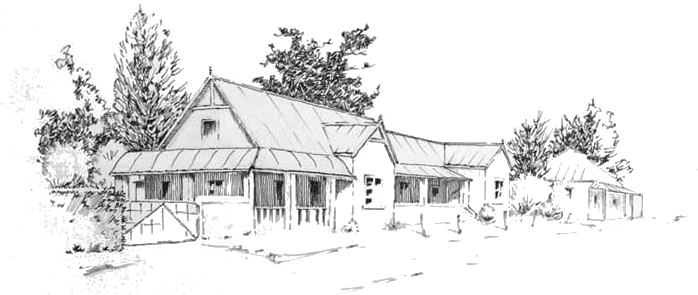
One of the pleasant highlights for me last year, and worthy of high praise, was the efficiency and reliability of the South African postal services, at least judged by my own experience. Throughout 2013 I used the Rondebosch Post Office to send off copies of my books and artworks virtually weekly to anglers, both in South Africa and overseas. Not a single parcel went missing the entire year!
The Mirage dry fly – world class in its simplicity and efficacy
Click in images to enlarge them
I fished again on a steaming hot day with a sharp downstream wind. The water looked delightful and the occasional trout blessed us with half-hearted takes. Again, like on a previous trip earlier in the week, a tiny hatch of the jet black mayfly came off, most likely Choroterpes nigricans, but strangely we never saw a rise all day. But we did get more than a few fish to take a dun-coloured Mirage dry fly, a single feather CDC pattern developed by Italian fly tying ace, Agostino Roncallo.
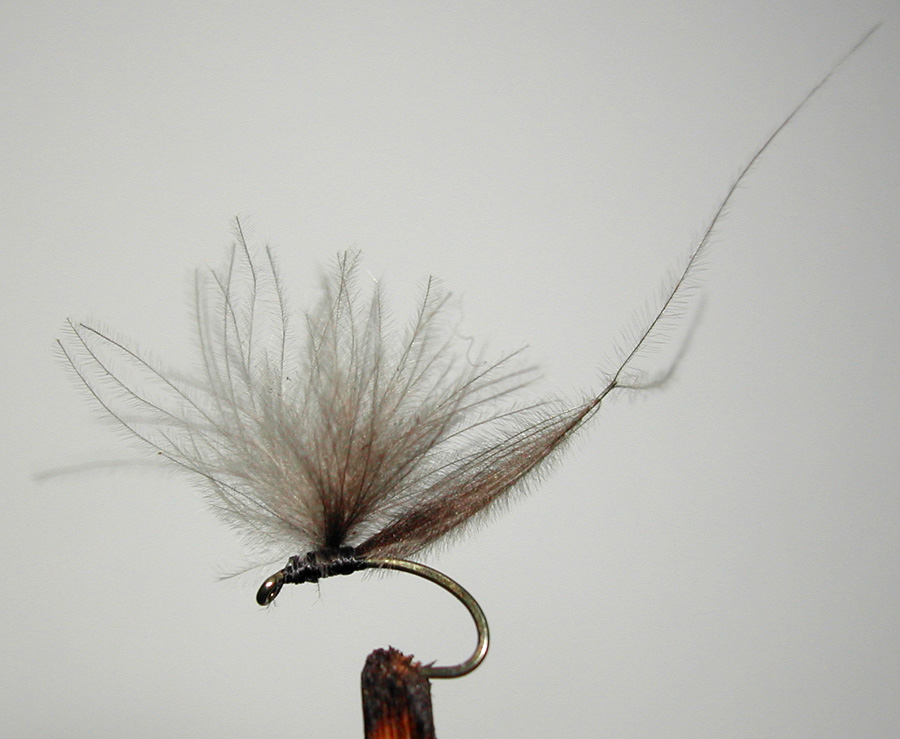
The Dun Mirage. Photo per Agostino Roncallo. (I add a little black Ice Dubbing to the thorax.)
Agostino rates this as the best fly he has ever developed. As an all purpose dry fly, especially on clear, quick flowing mountain streams, I don’t think it’s easily beaten, although Philip Meyer’s Para-RAB pattern has plenty of devoted followers here in the Western Cape – and for good reason.

The Olive Mirage. Photo per Agostino Roncallo.
The Mirage presents very lightly and looks extremely lifelike on the water. It also happens to be easy to tie. See Agostino’s article at http://www.tomsutcliffe.co.za/fly-fishing/fly-tying/item/215-the-mirage-mayfly-imitation.html.

Tying the Mirage. Steps and sketches submitted by Agostino Roncallo
Redfins and other indigenous Western Cape freshwater fish
I referred in last week’s newsletter to an angler finding small fish in the Witte River, a premier brown trout stream in the Western Cape. These were identified as Burchell’s Redfin. Craig Thom, proprietor of Stream X fly tackle store and NetBooks, wrote in as follows:

Burchell’s Redfin
With respect to your last newsletter and the local fish populations, I have been recording as many streams and tributaries where trout and local fish enjoy the water together. These pictures are from a Breede River tributary I explored this weekend.

My big toe is included for size comparison. Although some of the redfins are quite large, smaller ones have no red on the caudal fin, and even smaller ones have no red at all. I am assuming they are the same species. I found no galaxias in this tributary.

(NetBooks, offers a marvellous selection of books and DVDs on fly fishing, natural history, birds, Africana and photography and they provide a fast and reliable countrywide mail order service. See http://www.netbooks.co.za/Tel: 021 551 4248. TS.)
Using a 100 mm macro lens on rivers
I used just one lens on the stream the other day, a Canon 100 mm macro. It sounds a strange choice, but it has merit. Firstly I was able to shoot the Choroterpes mayflies we saw and I also got a few very useable close-up pictures of trout. The 100 mm macro also makes a marvellous general purpose lens when you are little way off your subject. Here are some of the 100 mm images from the day:
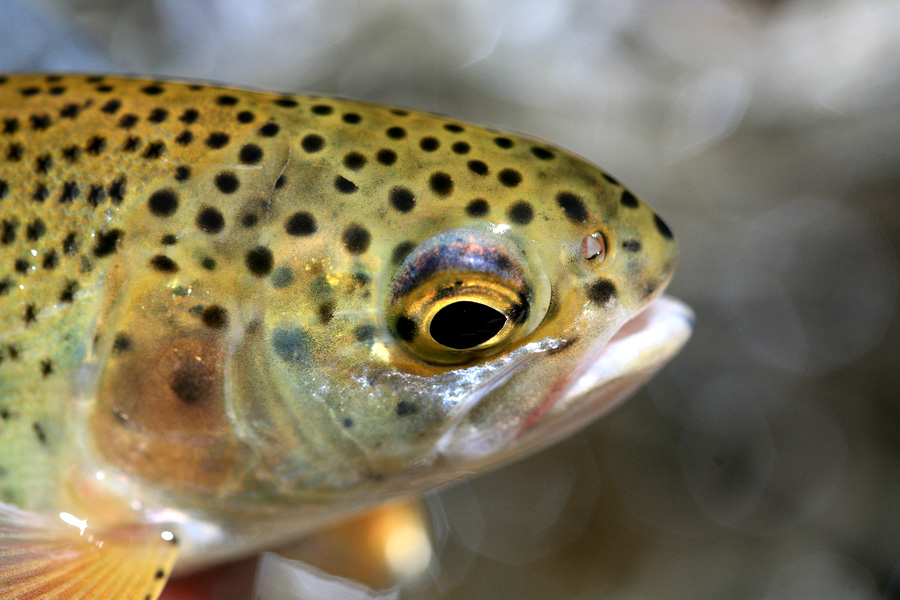
Trout close up

Choroterpes Mayfly

Robin Douglas

Ian Douglas behind the glasses, Robin Douglas to the right and myself behind the camera


Towards the end of this spell I was standing in a pool of shade when I saw what looked like a long bunch of autumn leaves rippling across a patch of bare ground nearby me. It was a brightly coloured puffadder!
I mentioned the sighting to my Robin and Ian, adding the important caveat that way over 70% of the puffadders I have come across on streams have been in the water rather than on the bank. It was news to them. Not that long back Billy de Jong and I chalked up five puffadder sightings in the space of two to three years, and all but one of them was right in the water with us! So keep this in mind when next you’re out wading.

A puffadder in a run on the Smalblaar River Western Cape
The seine landing net attachment
I mentioned in last week’s newsletter a very useful seine mesh that attaches to standard landing nets for scooping up insects. John Yelland of Upstream Flyfishing let me know that he has them in stock in two sizes.
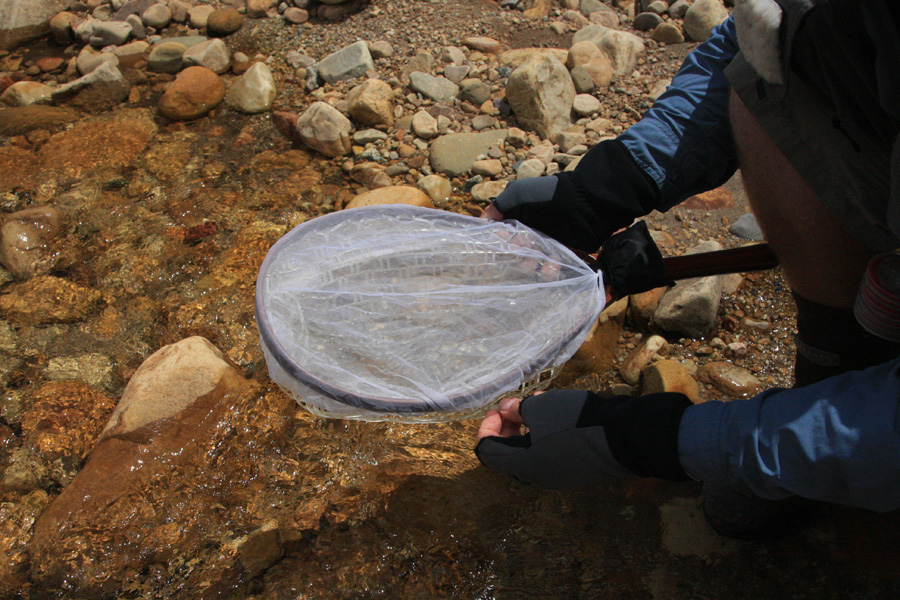
http://www.upstreamflyfishing.co.za/Tel: 021 762 800
Images of the week – Reflections

The Smalblaar River Western Cape Province

The bridge above Branksome Eastern Cape Highlands

Dead tree in Birkhall Dam Eastern Cape Highlands

Mark Yelland on Banana Dam near Dordrecht

Owl Dam Highland Lodge Eastern Cape
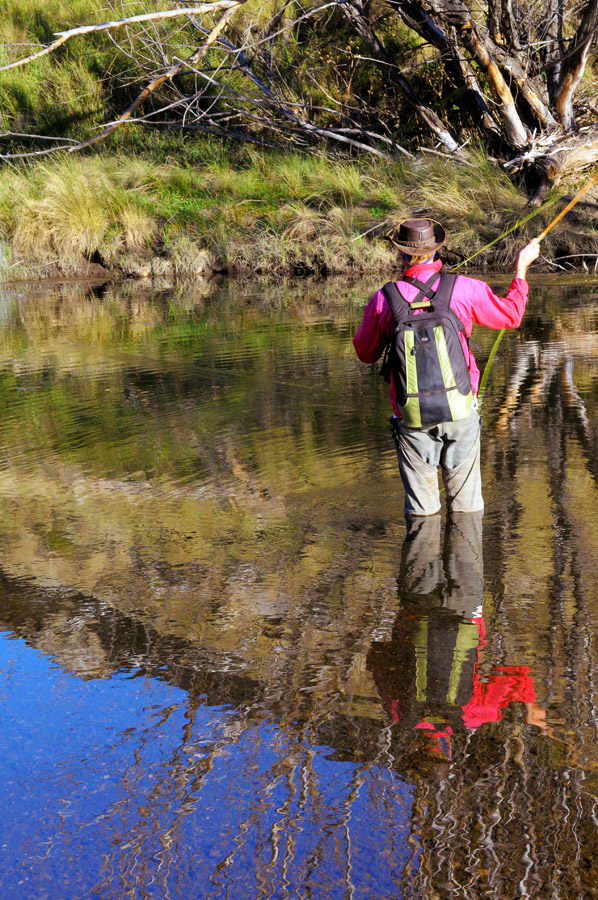
Bokspruit River Eastern Cape Highlands
Ed Herbst visits Somerset East and finds a mind-blowing fishery
Ed Herbst just returned from a visit to the small Karoo town of Somerset East where he was the guest of Andre and Gia de Goede. An article for my website will be posted soon where Ed will describe a visit to the Darlington Dam 90 minutes drive from town. It is a large expanse of water fed by four streams and at times, offers sight fishing to barbel up to 10 kilograms, monster carp, yellowfish, moggel, Orange River mudfish, eels, tilapia, and even freshwater mullet. Ed was in the company of my good friend Al Spaeth and Alan and Annabelle Hobson, owners of the Angler and Antelope guest house in Somerset East.

Al caught a 10 kg barbell on a dry fly! He took it on a Good Doctor’s Beetle, that ended up with its hook gape somewhat widened.

See Alan Hobson’s article on fishing Darlington Dam at: http://www.doitnow.co.za/content/darlington-mermaids-and-rooibos-tea-0#sthash.06jy5XWV.dpuf
And Ed’s previous article on the Angler and Antelope at:
http://www.tomsutcliffe.co.za/fly-fishing/friend-s-articles/item/201-alan-and-annabelle-hobson-a-profile.html
Quote of the week
The wildness and adventure that are in fishing still recommend it to me.
Henry David Thoreau Walden (1854)
Wishing you all a wonderful New Year – Tom Sutcliffe